

 Facebook
 Вход

 225


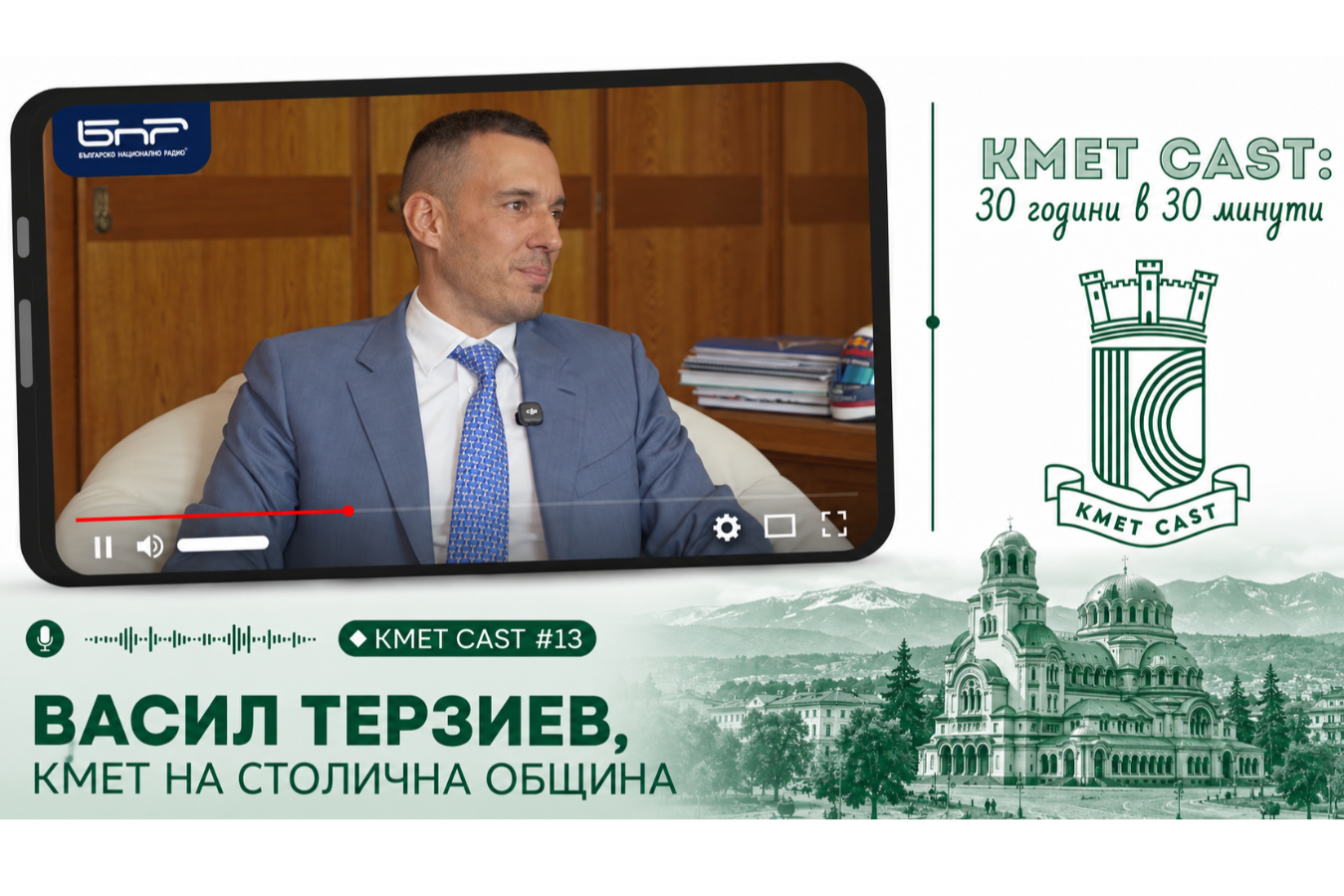
On the eve of Sofia Day, “Kmet Cast: 30 Years in 30 Minutes” returns for a new season of BNR Podcasts. The guest in the joint series produced by the National Association of Municipalities in the Republic of Bulgaria (NAMRB) and Bulgarian National Radio is Sofia Mayor and NAMRB Management Board member Vassil Terziev.
In his conversation with host Veselina Milanova, he discussed the role of the Association, the need for fiscal decentralisation and the main challenges involved in governing Bulgaria’s largest municipality.
“NAMRB is one of the organisations that can take pride in its remarkable resilience over the years. This is due to its ability to uphold a long-term vision for the development of local self-government and always to be the voice of what unites us as municipalities—regardless of political affiliation or the size of a particular municipality,” Vassil Terziev emphasised.
According to him, municipalities vary in size, but the challenges they face are similar. Fiscal decentralisation remains one of the major shared priorities that NAMRB has consistently raised and defended.
“Decentralisation would give all mayors much greater freedom, particularly the more proactive ones who have a clear vision for the development of their cities. There should be a direct link between attracted investment, economic progress and the resources retained by the municipality for reinvestment,” Terziev said.
In his view, the current model leaves municipalities dependent on decisions made by central government. For Sofia, genuine decentralisation would mean more resources for infrastructure, the urban environment and key long-term projects. A lack of sufficient funding, however, should not become an excuse.
“Ultimately, you are elected to solve problems, not merely to talk about them. Citizens already know those problems well enough. No matter how difficult the situation may be, my job is to find the best possible solution under the circumstances,” the Sofia Mayor stated.
Among the serious challenges facing Sofia’s administration, he also highlighted the lack of sufficient high-quality data, systems and effective processes on which to base long-term decisions. The discussion also addressed specific issues on the capital’s agenda, including the future of Toplofikatsiya Sofia, cleanliness and waste management, public transport, educational infrastructure and the shortage of places in nurseries and kindergartens.
With regard to cleanliness, Terziev explained that the new contracts introduce higher requirements for equipment and service quality. A different model for collecting bulky waste will also be explored.
“The goal is not for Sofia merely to reach an acceptable standard of cleanliness, but truly to become an exemplary city. This is what we are working towards, and I hope there will be a significant improvement by the end of the term,” he said.
Educational infrastructure was another focal point of the conversation. A total of 45 schools in Sofia need to move to single-shift operation, with 39 of them requiring extensions and substantial investment. According to the Mayor, 20 kindergartens have already been built, renovated or brought into operation, another 15 are under construction, and further projects are being prepared.
Nursery groups and the shortage of more than 230 nurses remain a major challenge.
“There is no single magic-wand solution. What is needed is a combination of five or six different measures. Once we understand how each factor contributes to the problem and have a clearly mapped-out path, finding the solution becomes a matter of time,” Vassil Terziev said.
At the end of the conversation, Vassil Terziev once again highlighted NAMRB’s ability to unite local authorities around shared objectives, regardless of political differences.
Watch the full conversation on these and other topics concerning the capital HERE.
NAMRB would like to thank all the mayors and their teams who contributed to the series and made the production of “Kmet Cast: 30 Years in 30 Minutes” possible.
Special thanks also go to the Bulgarian National Radio team from BNR’s Digital Programmes Directorate:
Author: Veselina Milanova
Camera Operator: Kristian Bozov
Editor: Mihail Mihov
Producers: Violeta Ashikova and Zlatko Zhelev
Executive Producer: Ivo Todorov

png.png "За еврото")
png.png "КАМПАНИИ ПРОЕКТ УСПЕХ")


